
DISCLAIMER: This blog contains some profanities. Sorry, but I feel strongly about some of the content. It may also be a bit controversial and blunt at times. Again- this is important to me and it should be important to you too.
Getting Advice
When you’re expecting a baby and during the first year – you will get a LOT of advice. And I mean A LOT. (See Parental Disclaimer). By “advice” I’m talking about the generic bits of information targeted at all the parents. What to eat, wear, do with your baby so they come the other side live and kicking. Visiting a doctor and getting specific help for an illness etc isn’t covered here, but will be in an upcoming blog!
This advice will come from various sources. I’ve ordered them by how much you should listen to them:
- Midwives: They will be the most important people you will get to know. Just follow their advice even if it sounds weird (they’re probably hiding the true meaning – more on that later).
- Children Nurses (eg the nurse who vaccinates your child): Much like the midwives, these guys do this day-to-day and can give super helpful and reassuring advice.
- NHS class teachers: These guys are super up to date with the latest research available for the content they’re teaching. Listen to them!
- Health Visitors: They’re super paranoid and will say anything to keep your baby safe. Don’t be panicked by them, they mean well.
- Friends with young babies: They’ve survived all this recently and will know some great tips and more importantly give you “real-life” practical advice.
- Your GP: They’re not as high as the above medical professions as they don’t specialise in children, but obviously they’re trained in medicine so hopefully know what they’re talking about. You may be confused to why you may trust your friends with babies more: well they will hopefully be passing on advice from their doctors too. So more sources of information tends to always be better than one.
- NCT teachers: You go to NCT (antenatal classes) to make friends (see #5!). Please don’t expect to learn much, or you will be disappointed. But they should still have important things to say, so listen up and take notes!
- Your parents: Obviously you’re alive so they must know something. And this is something they will tell you every other sentence, especially as you roll your eyes whilst they suggest to give your baby a “nip of brandy”. Don’t be fooled by survivorship bias (more on this later) – but do listen to them. They do mean well, they will love your baby and whilst they won’t be up to date with the current research, they will still know a few lifesaving tips!
- Friends without babies: There’s only so much someone can know about babies without having one. If their advice is second-hand advice from other friends with babies, beware of Chinese whispers. But they probably mean well, so just do your own research first before trusting them fully.
- Random strangers on the street: Yup, they’ll be more than happy to advise you on your baby’s clothes, buggy, food or lifestyle. Just smile, nod and gently persuade them to fuck off.
- Anti-Vaxxers: If you are talking to someone who wants their child to have a higher risk of dying to horrible and fatal diseases like Polio, Meningitis or Diptheria, you need to change their mind immediately. If they still don’t listen to straight up facts about the subject, ensure you and your child keep as far away from them as possible. Seriously, it makes my blood boil seeing news about new outbreaks of easily preventable fatal (did I mention they are FATAL) diseases because of selfish idiots not vaccinating their children. If this offends you, good, now go take a running jump off the Flat Earth you probably believe in too.
Please note, the above list is based on MY and my wife’s experiences. You may have amazing doctors or terrible midwives – so always be wary and skeptical. How will you know then who to listen to? The next sections describe some common pitfalls to avoid and what you should be doing to better educate yourself.
Survivorship Bias
“Well, I did this with you as a baby and you survived”
“1000s of babies survived before we knew about this, so it can’t be that good”
“In <insert country> everyone does this and they survive”
“We didn’t have this when we were cavemen and the human race survived until now”
Do these phrases sound familiar? These are all based on Survivorship Bias (https://en.wikipedia.org/wiki/Survivorship_bias): the logical error of only taking into account the successful data and ignoring the failures.
They also all overlook the key point about advice, especially from the medical profession. Advice is NOT (normally) tailored perfectly to the individual and is instead a proxy to try and reduce the risk of failure (death, obesity etc). This doesn’t mean that it is guaranteed to work, it won’t have a 100% success rate. But may mean 100s or 1000s more babies in a population of millions will survive than before. Sometimes it is by a small percentage (eg the ever changing ‘best sleeping position’ for avoiding SIDS) and sometimes by a large percentage (eg not blowing cigarette smoke directly into your babies face or not vaccinating!).
At the end of the day, it is the parents’ choice to evaluate the risk and choose to follow the advice or not. My advice would be the following:
- Ask the question: “why not?”. Will your life really be that inconvenienced by not doing it to offset any risk to your child, regardless how small?
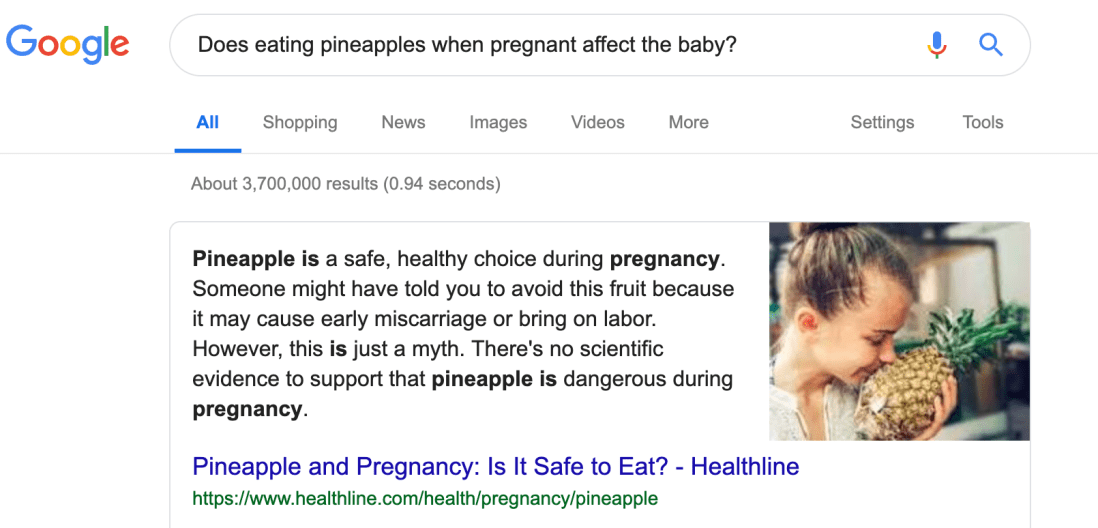
- Question the data and sources given, are they reliable? It doesn’t take long for Google to give you a quick answer to the validity of the advice. Eg “Does eating pineapples when pregnancy affect the baby?”
- If the advice relates to a particular culture or country, statistics are readily available to help you decide if you trust them (see next section).
Side note: I was going to use the examples of seatbelts to show how a large percentage of lives can be saved by wearing seatbelts (most empirical data points to around 50% reduction of fatalities in car accidents) may still only be a small absolute number (15,000 per year in the US) https://www.cdc.gov/motorvehiclesafety/seatbelts/facts.html). Therefore the likelihood of this affecting you is arguably small, however in the eventuality of you having a car accident, it would be crazy not to wear a seatbelt.
However, my research then led me to this interesting book “Risk” by John Adams (Amazon link ). I invite you to read the chapter “Road Safety 1: seat belts” (via the Amazon preview) whereby he argues that due to an increase in perceived safety, the risk tolerance of drivers went up and in fact government policies to enforce wearing seat belts has in fact lead to a greater net increase of car accident fatalities due to drivers being more reckless. Further he argues that, instead, the burden of risk is merely moved from the driver to those outside the vehicle.
This doesn’t undermine the facts that for those in the car, wearing a seat belt is consistently proven to be safer during an accident (and he agrees) but from a society point of view, the results of enforcing this by law has had an overall detrimental impact.
Personally, I think that the facts around wearing a seat belt being safer in an accident are proven and the rise in accidents overall is more contrived and potentially not as highly correlated. Also, his findings are now fairly old and the mindset of drivers now will be affected by more factors than before with better car technology etc. I certainly won’t be not wearing a seatbelt anytime soon, and I don’t think I take more risks when driving because I do.
Give it a read and let me know what you think!
How do the NHS give advice?
The NHS have the big task of educating the UK population on how to safely raise their children and keep the infant and maternal mortality rates low. To give you an idea of the numbers and how UK compares to the rest of the world, here’s some side by side comparisons taken from cia – infant mortality rate and cia – maternal mortality rate:
- Infant mortality (numbers: number of deaths per 1000 (lower better) and rank in the world (higher better)):
- Slovenia: 1.6, rank: 224/224 (Go Slovenia!)
- Sweden: 2.6, rank: 216/224
- France: 3.2, rank: 209/224
- Switzerland: 3.6, 198/224
- UK: 4.2, rank : 190/224
- USA: 5.7, rank: 170/224
- China: 11.8, rank: 118/224
- India: 37.8 (30.24 to 230.24), rank: 46/224
- Afghanistan: 108.5, rank: 1/224
- Maternal mortality (numbers: number of deaths per 100,000 (lower better) and rank in the world (higher better))::
- Finland, Greece, Iceland, Poland: 3, rank: 184/184
- Sweden: 4, rank: 180/184
- Switzerland: 5, 174/184
- France: 8, rank: 157/184
- UK: 9, rank : 155/184
- USA: 14, rank: 139/184
- China: 27 rank: 118/184
- India: 174 (139.2 to 339.2), rank: 56/184
- Sierra Lione: 1360, rank: 1/184
Jem kindly pointed out that a number of birth and deaths (25%) aren’t registered in India, hence the ranges provided.
To sum those statistics up, UK isn’t doing too badly! But there is always room for improvement, so the NHS’ job is to keep those numbers low and if possible even lower. This means the advice based on current research will have smaller beneficial impacts than before – resulting in it being contradictory and seemingly pedantic sometimes!
Let’s take a look at what I reckon the decision tree is:
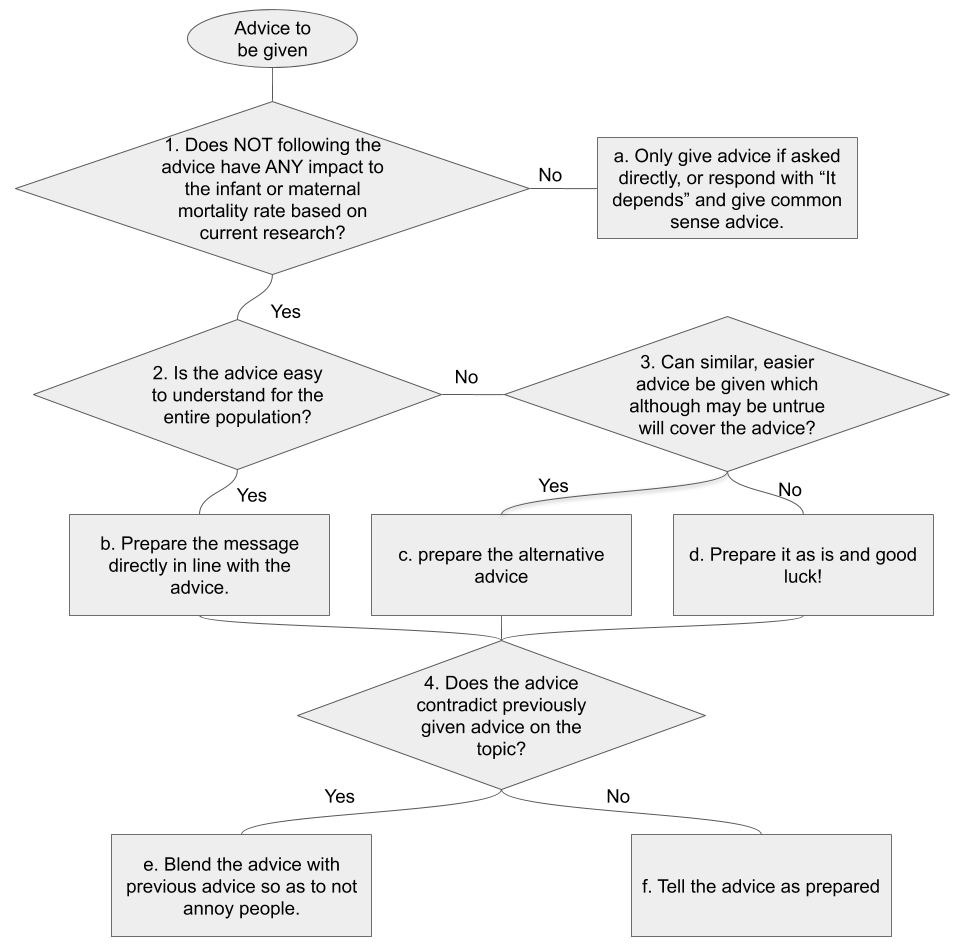
Some examples for the numbered boxes in the chart above
- The colour of your child’s hat.
- Don’t give your baby alcohol.
- They advise that babies main source of food is formula or breast milk up to 1 years of age. If the baby is allowed to drink cow’s milk, then that could mean replacing the milk they need. But cow’s milk isn’t harmful and in fact is OK in cereal for example – but that can be confusing. So instead you hear: “don’t give them cow’s milk”. Simple.
- All breastfeeding tips… man it gets confusing!
- The current research points at solid food before 1 year old isn’t nutritionally beneficial to the baby (or at least no where near as much as breast/formula milk). However, all the top nutritionists have been saying that purees are the best and how to wean. The advice now is to limit purees to 8 weeks, then start introducing finger foods and baby led weaning soon after.
- Put your baby in a car seat, backwards is safer.
As you can see in the chart, sometimes what you hear isn’t what they want to say. Eg “eat your 5 a day” really means, eat a balanced healthy diet. But the latter is hard to describe and the former dead easy. They need to reach as many people as possible whilst also keeping up to date as possible, so bear that in mind before rolling your eyes 🙂
To sum up this lengthy blog post, when receiving advice about your babies it may be a confusing process. You need to be careful that it is sound and based on reliable evidence. You may also be confused to why it’s different to before, or why it seems pointless. You cannot research everything, who has the time, but don’t take everything at face value, trust that it’s coming from a good place (mostly) and at the end of the day trust your instincts. You will know your baby the best, because as a parent (especially a mother) you are amazing.
I mean, just look at how amazing Jem with Zeffie 🙂

 Daddy Coder